


It was the best of times, it was the worst of times, it was the age of wisdom, it was the age of foolishness, it was the epoch of belief, it was the epoch of incredulity, it was the season of light, it was the season of darkness, it was the spring of hope, it was the winter of despair, we had everything before us, we had nothing before us, we were all going direct to heaven, we were all going direct the other way–in short, the period was so far like the present period...
These were the opening words of Charles Dickens’ 1859 book about the French Revolution, A Tale of Two Cities. These words will mean something if you are paying attention to what the Dickens is going on everywhere today.
Dickens wasn’t exactly a historian. He was a romantic novelist. A Tale of Two Cities is a fine story. But it is a “tale”. It is hardly an accurate history of the momentous events occurring in that momentous time.
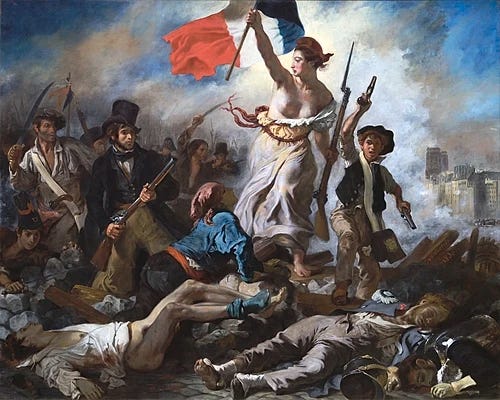
The French Revolution was not one event, but many that erupted, were stamped out, erupted again, fizzled and simmered for a century or more. They are still erupting, fizzling and simmering. In the process, the French - particularly the Parisians - learned how to make effective street barricades by piling up cobblestones, metal railings, garbage dumpsters, road signs, manhole covers, building bricks, overturned cars and busses... and how to make one from scratch really fast.
The point of the street barricade is not to facilitate looting. The point of the street barricade is to get the attention of the ruling class. Nothing gets the ruling class’s attention so much as damage to property, particularly their property. Which is pretty much everything, especially where, as in most of the West, the private sector owns the state (which, by the way, is a shorthand definition of fascism). The point of the street barricade is to gum up everything. The point is to prevent business as usual.
These days it’s difficult to distinguish genuine revolutionary fervor from so-called “color revolutions” that are orchestrated by covert operatives pulling the strings of impressionistic naifs. Generally speaking, genuine revolutions are characterized by an awareness of class, rage, gross economic disparity, and political impotence. This includes the shoeless Sans Culottes of the French Revolution (literally, the pant-less ones who could not even afford to buy clothes) or the women’s march on Versailles.
The women’s march on Versailles was a bread riot led by starving mothers. They took up arms, marched from the fish market to the palace and seized the King and Queen. The next day, thousands of weapons-wielding women then hauled the Royals from the Palace of Versailles back to Paris where they were held in the 18th Century version of “home detention,” sans electronic ankle monitoring bracelets, of course. Later, the King and Queen did the equivalent of cutting off their electronic ankle monitoring bracelets by surreptitiously fleeing Paris. This was the royals’ “Flight to Varennes,” which was itself arrested by another hastily assembled barricade built of discarded furniture to block their escape. And that barricade, in turn, led to Louis and Antoinette losing their heads.
Anyway. The women’s march on Versailles signaled the absolute end of absolute monarchy (except in such retrograde puppetocracies as Saudi Arabia). It was a remarkable demonstration of revolutionary chutzpah... and women’s rights.
The French Revolution might have been more bourgeois than working class, but it was genuinely revolutionary at least in principle. Other “genuine” revolutions include the Russian Revolution of 1917, the Chinese Communist Revolution that culminated in 1949 with the establishment of the PRC, and the Cuban Revolution of 1959. The Cuban Revolution - yes, that one led by Fidel Castro and Che Guevara - overthrew the corrupt military dictatorship of Fulgencio Batista, the likes of which the United States is keen to reinstate.
Ersatz “color revolutions” are typically inaugurated by dangling the glass beads of “democracy,” consumerism, easy money, “modernity,” sex, drugs and rock ‘n role. Color revolutions typically rely on the assistance of local compradors and collaborators who, as in every society, are willing to sell themselves for a bag of silver coins. The ersatz revolutions include the likes of the “Orange Revolution” in Ukraine (2014), the dismantlement of Libya (2011) and Syria (2025), and the failed color revolutions of Tienanmen Square in Beijing (1989) and Hong Kong (2019).
There were at least four “revolutions” in France - 1789, 1830, 1848 and 1871. All of them scared the bejeezers out of Europe’s aristocracy. The French Revolution ranged from the storming of the Bastille to the guillotining of Louis XVI and Marie Antoinette to the Paris Commune. None of these were completely successful and all of them, ultimately, were unwound by counter-revolutions. But they all were, nonetheless, “revolutions” that professed (in the emancipatory idiom of the American Civil War) an intention to put the bottom rail on top (even if it was only the bourgeoisie who ended up on top). The class consciousness of these uprisings is revealed in the bloody, vivid lyrics of the French National Anthem, La Marseillaise.
Another near-revolution occurred in 1968 when Parisian students rose up again. In the same year, German students - particularly in Berlin - staged their own massive demonstrations against the US-UK installed Shah of Iran (another puppetocracy), against the Vietnam War, against the pro-business policies of the German State, and against the attempted assassination of student activist Rudi Dutschke. All of which should sound familiar if you substitute the players and geography of our current times. Plus ça change, plus c’est la même chose.
I was in Berlin at the time of the 1968 protest demonstrations (the Freie Universität Berlin was close to where I lived). I remember motor-scootering and mopeding with high school friends to the university student hang-out at the Annapam Café. If I was too young to participate and too stupid to understand, I can still validate the excitement of the times, even if they have been airbrushed.
If history does not exactly repeat itself, it certainly corkscrews around in familiar spirals. It’s a corkscrew because the fundamental problems that result in the vast majority getting screwed are hardly ever resolved except cosmetically. So it’s no mystery that for every step forward humans take, there are vested class interests that kick us two steps back.
Periodically, young people grow angry with the sordid world bequeathed them by their parents’ generation. Today, it’s “Gen Z.” They should be angry. The Baby Boomers failed to accomplish very much except ending the draft. As soon as the Vietnamese people won the War, the Boomers were easily seduced by the capitalist siren of Wall Street, consumerism and hedonism masquerading as “freedom.” In sum, the Boomers became their parents. The Boomers’ failure to evolve sowed the seeds of the next generation’s malaise.
So here we are.
It has been the best of times for a small class of extremely wealthy and powerful people. It has been the worst of times for the majority “others” (to quote another Dickens’ title) whose Great Expectations have been betrayed by parasitic legerdemain in economics, technology, politics, education, law, endless war and anti-social re-engineering.
Right now, there is large scale student unrest in France, in Albania, in India, in Italy, in Germany, in Indonesia, in Spain, in Paraguay, and almost everywhere else you look. Reading the western press you get the impression that nothing is happening. Or, if it is, it is all due to “immigrants” and so-called “Black Block” Antifa radicals and opportunistic looters. So has the media always demonized social unrest as the criminal activity of a malevolent minority.
* * * * *
Except for particularly horrific events that you cannot avoid seeing (like the assassination of Martin Luther King in Memphis 1968 or the beating of Rodney King in Los Angeles in 1991), Americans generally have been conditioned to be phlegmatic. We are conditioned to channel our frustrations into children’s games, theater of the absurd and “voting”
Nevertheless.
The 2026 midterm elections delivered a well-deserved kick in the butt to the disgusting politicos du jour.
It was fun. It was exhilarating. I tip my hat and especially applaud the victories of the more courageous non-establishment candidates such as in Michigan, Texas, Los Angeles, Georgia, Mississippi, and South Carolina. I relished the defeat of the bull-shitters and their handlers. I felt great schadenfreude as AIPAC (camouflaged in its various super-PAC alter egos), Miriam Adelson, Elon Musk et. al. poured so much of their ill-gotten money down the campaign drain to accomplish so little.
Still, I am certain that the 2026 midterm election was more a protest vote against the ruling Republican regime and its polices (”Make America Medieval Again“) than an endorsement of the old guard Democrats. To the extent the 2026 election was a vote for anything, it was for the more socialist-leaning young candidates. The 2026 midterm election was NOT a vote for business as usual or the OPFs (the “Old Party Farts”) of the status quo ante. It was certainly NOT a vote to substitute one war for another. It was not a vote for a game of political musical chairs. It was not a vote for genocide.
The recent “blue tsunami” was a form of electoral barricade to force the system to fundamentally change, not just to change the color of the lipstick on the pig.
* * * * *
In 2026, well before the midterm elections, some Seattle residents in the north of the City also built barricades. Not like Parisian barricades, but barricades nonetheless. These, too, were a plea for attention.
Seattle did manage a three day general strike and worker uprising way back in 1919. It was one of the few real general strikes pulled off in the United States. But Seattle people, by and large, are now very polite and law-abiding. Thus, the local pols were surprised when North Seattleites erected their own neighborhood chicanes and obstacles.
The 2026 Seattle barricade-builders were protesting the City’s failure to shut down tawdry sex trafficking and open air drug-dealing along Aurora Avenue, a law-free zone such as is tolerated in every American big city. The cities create these “combat zones” in order to concentrate the crime in a politically weak and poor part of town, away from the more affluent neighborhoods... except for the Jeffrey Epstein type of upscale sex-trafficking, kompromat and gentleman’s clubs that are run by hush hush agencies for the rich and powerful in posh NYC townhouses, remote Caribbean islands and secluded desert resorts.
The 2026 Seattle barricades, unlike those constructed by the French, consisted mostly of metal planter boxes suitable for growing fruits and vegetables. This is very Seattle! These barricades were environmentally conscious, neat, functional, easily put in place... and just as easily removed by the City.
Of course, after the barricades in North Seattle were removed, the sex and drug-trafficking then continued unabated. Just like the Jeffrey Epstein kompromat/gentleman’s clubs that also, I am sure, continue unabated, but outside our field of view (albeit sans Mr. Epstein who was likely suicided to protect his patrons and clientele).
* * * * *
Decades ago I lived in another Seattle neighborhood where we also had a crime problem. It was nothing on the level of prostitution or drug-trafficking, but irritating nonetheless. It was a matter of “traffic calming.” You know, how to slow down the speed and volume of commuters driving through other peoples’ neighborhoods en route to work or home in another neighborhood.
We complained about the noise and pollution to the City which, as usual, did nothing. We were derided as not-in-my-backyard NIMBYS. Calling you a NIMBY is how the powerful dump on those who oppose their plans to socialize the costs while reaping the profits of their water-and-power sucking data centers, nuclear power plants, airports, toxic waste sites, oil and gas fracking, military bases, and similar undesirable undertakings.
Put it in your backyard, they preach!
Put it in YOUR OWN backyard, I answer!
But Seattle was a different kind of town even back in the early 1990s. If the City wouldn’t do anything to calm the traffic then we, in the spirit of the 19th Century America described by de Tocqueville, would do it ourselves. We formed a neighborhood committee and got “permission” to build our own “traffic circle,” at one particularly chaotic 5-way intersection. The City agreed so long as we did the work and maintained it ourselves, and so long as we simply laid the structure on top of the existing asphalt, rather than break it up.
And so we did. The City laid the outline of the large oblong “traffic circle” with yellow curbstones on top of the asphalt and we filled it with dirt, flowers, shrubs and bird houses. In the middle of this large oblong round-about, the City erected the usual signage showing drivers how to circumnavigate it.
So far, so good. The noise was lessened. The traffic slowed down. Like a street barricade, a traffic circle slows things down. Like a barricade, a traffic circle commands your attention.
Except that our neighborhood lay close to the main campus of the University of Washington and someone (we think it was a resident at a local fraternity house) periodically, and typically on a Saturday, would drive a pickup truck through the community very late at night. The truck would announce its arrival with a cacophony of screeching tires, chrome cut-out exhaust pipes, and a 10 million watt sound system fitted with Richter Scale 10 woofers and tweeters. This person (or several persons) would drive his/her/their honking big extended cab pickup truck with a row of spot lights mounted on a chrome roof rack, over-sized off-road knobby tires, black out windows, and 4X4 transmission right through and over our community-built traffic island leaving in his/her/their wake a trail of destruction, mangled plants and deep tire tracks, much like a wild animal marking his/her/their territory by peeing on it.
We rebuilt the traffic island. It happened again. We rebuilt. I happened again. And again. And again.
We complained to the City. The police looked. They made reports. They did nothing. More than likely, the City was as happy to simply remove our traffic-calming island as to catch the malefactor who repeatedly wrecked it.
At this time, our community was not yet imbued with that learned helplessness that characterizes so many in the western world. Some of us - even today I’m not sure exactly who - undertook to defend our traffic island ourselves. Someone - I’m not sure exactly who - procured a truckload of hefty, angular boulders that were then installed like dragon’s teeth around the circumference of the traffic circle. The dragon’s teeth were then dressed with small plants, flowers and vines.
Not long thereafter, on a Saturday night, we again heard the snorting of our nocturnal visitor. The motor roared, the tires wailed, the sound system brayed, and the midnight marauder drove right over our traffic island again... accompanied by the abrasive sound of grinding stones whetting steel. The truck’s undercarriage was ripped apart. A dismembered muffler and a piece of a shredded oil pan clanked and bounced around the pavement. The wounded wheeled beast hemorrhaged motor oil like a stream of dark blood. The truck’s engine wheezed, seized and died several blocks away. A few days later, the truck carcass was towed away.
The traffic circle was again repaired. No one called the police. The midnight marauder never returned. The traffic circle remains in place to this day. The barricade, the plants, shrubs, bird houses... and the dragon’s teeth... are still there.
As lawyer, of course, I recommend that you not try this in your own neighborhood with or without adult supervision. After all, we have laws in this country. So I’m told.
As for my own Seattle neighborhood three decades ago, I have no idea who did it. And if I ever did, age is as good an excuse as any not to remember. And, besides, the statute of limitations has surely run.
* * * * *
More Seattle barricades.
Seattle was a different kind of city even in 1999 at the tail-end of the 20th Century.
When it comes to the shut-down of the World Trade Organization, I can speak with the conviction of my own authority: I was there.
Bill Clinton was the President of the United States at the time - he who felt our pain even as he inflicted it. Madeleine Albright, his Secretary of State - she who thought that the price of U.S. sanctions killing half a million Iraqi children was “worth it“ - lodged at the Westin Hotel preparing for her address to the WTO main assembly. Gary Locke, the Democratic Governor of Washington State who promoted “free trade” with China, was also in town.
Funny, isn’t it? At the end of the 20th Century, the West was a huge proponent of “free trade” and investment without borders. Twenty-five years later, the West - completely unable to compete even by its own crooked rules - switched to promoting “protectionism” and the erection of tariff barriers to “free trade.” So turns the screw that screws us all.
So it seems that “tariffs” are the capitalists’ own “barricades.” But unlike the ones built by real people, the protectionists won’t ever try to tear theirs down.
It was the end of November 1999. Twenty-seven years ago to the month.
My law office, at the time of Seattle’s WTO annual meeting, was on the 21st floor of the Westlake Center Tower. That was ground zero, across the street from the Westin Hotel WTO headquarters and just a couple of blocks away from the WTO main ministerial meeting at the Washington State Convention Center. I looked down 21 stories from my window and watched the long parade of steel workers and IBEW unionists marching down 3rd Avenue heading toward Westlake Park. I was drawn into it like a moth drawn to a candle.
The WTO protests in Seattle, in a sense, birthed this Hippomuse SubStack. When I went down on the street, I was still wearing my dark lawyer’s suit, a dark overcoat and a hand-tied silk bow tie. The streets were packed. The limousines of WTO delegates were completely bottled up, completely surrounded by peaceful demonstrators. The entrances to the Washington State Convention Center were blockaded by peaceful protesters, sitting and standing shoulder-to-shoulder.
Impassable.
Everywhere, there were signs, flags, placards, people walking on stilts, people costumed as sea turtles, people giving away home baked cookies, chalk artists drawing political cartoons on the pavement, union workers in hard hats, busker musicians, puppeteers, advocates for and against every conceivable cause, environmentalists singing folk songs, people dancing, indigenous people wearing indigenous costumes, people banging pots with wooden spoons, people with dogs, people with parrots, jugglers, mountaineers climbing atop and then dropping anti-WTO banners from tall construction cranes, little children performing street theater, people chattering and chanting in dozens and dozens of languages.
It was like a party with 60,000 very civil, but very disobedient guests. And if traffic was brought to a complete stand-still and the doors to the convention center blocked by human barricades, there was not a single instance of violence nor broken windows nor looting nor rioting anywhere. In fact, it was a pretty damn thrilling event that more resembled a giant street carnival than a protest demonstration.
Anyway. That’s how it began.
I remember standing on the sidewalk next to Nordstrom’s flagship store. The mass of people was a human barricade. A police cruiser inched slowly forward. The police cruiser jumped the curb and pinned me with its front bumper - me, the corporate lawyer, still wearing pin-stripes and a silk bow tie - against a Nordstrom showroom window. The police officer in the car (the car that had driven onto the sidewalk and pinned me against the showroom window!) spoke through a megaphone and ORDERED ME to get out of the street and immediately leave the area. I replied that I wasn’t “in the street,” (Mr. Policeman, sir). I was standing on THE SIDEWALK. And where, I asked, was I supposed to go? (Mr. Policeman, sir). I worked downtown, and I pointed across the street to my office tower.
But the police officer was no longer interested in me. Because right in front of our eyes, we saw a phalanx of heavily armored riot police charge into the peaceful crowd of demonstrators and begin to beat, shove and teargas them. It happened right in front of me. It happened repeatedly. The crowd was provoked to respond. The counter-violence ensued as the crowd fought back. Very soon after that, so-called “Black Block” Antifa-people appeared (who they were was never exactly clear - hooded anarchists from Portland, Oregon... or, most likely, provocateurs deployed by quasi-governmental contractors to create an “incident” that would justify them declaring a “riot” and the suspension of civil rights). The so-called “Antifa” folks began to smash store windows and to loot. The police did nothing to stop the “Antifa” hooligans who were violently breaking glass and looting. Instead, the police attacked the non-violent protesters.
The playbook is always the same. Just like in France 2026, in 1999, the Governor of Washington State called out the National Guard who surrounded the Westin Hotel. They declared that all public gatherings downtown were unlawful. So much for the First Amendment freedom of speech and right of assembly. Heavily armed police forced people into kettles and arrested them en masse. They were carted away and held for hours, without food or drink or toilet access, on locked and guarded transit buses miles away at Magnuson Park.
The Seattle anti-WTO protests continued for three days. It was the Battle of Seattle. Club-wielding riot police chased protesters up Denny Avenue onto Capitol Hill. On Capital Hill, the local residents poured out of their apartments and nightclubs and, joining the protesters, chased the riot police back down Denny Avenue into the city center.
Everyone got tear-gassed. They brought out armored cars; bicycle police; stun grenades; rubber-coated bullets that break bones, bruise your face and gouge out your eyes; and horse-mounted riot patrols. Enterprising street vendors sprang up selling gas masks, eye goggles and bottled water to rinse away the pepper spray. Somewhere or other, I still have the gas mask I bought in case I needed it (as an observer, of course).
I was still watching television in those days. I came home from what I had seen and watched the talking heads on local news channels explain how demonstrators had started to attack the police and how the National Guard had to be called out to restrain out-of-control vandalism and looting. I watched and listened to news reports that I knew, from first hand observation, were completely false, that were completely the reverse of what had happened. Just like in France 2026.
As with so many allegations of foreign hacking of computer systems or foreign terrorists, every accusation is actually a confession.
I pulled the plug on television that month. Since December 1999, I have watched no TV. I don’t miss it. There is a lot of noise in our world. The problem with noise is that it makes it difficult to separate out the important stuff. But, more than likely, that’s why the noise is there.
Shutting down the Seattle meeting of the WTO was a success. But the meetings resumed the following year elsewhere. Capital marched on. The people were appeased by bread, stock markets and circuses. The protesters were diverted to myriad and more divisive causes.
But there are causes and effects, and sometimes they show themselves slowly. For me, November 1999 marked the beginning of a steady personal evolution to my decision in 2004 to leave my mid-size law firm in downtown Seattle and step out on my own. My evolution continued through late 2023 when, having finally obtained a clearer, if still imperfect understanding of how things really work, I decided to start publishing Hippomuse at Substack.
* * * * *
These have been the best of times and they have been the worst of times. It has been an age of wisdom and an age of extraordinary foolishness. It has been an epoch of belief. It has been an epoch of astounding incredulity. It has been a season of flickering light and a season of deep, deep darkness. It was the spring of hope. It was the winter of despair. What the Dickens is going on?
The new barricades in France and elsewhere will have an aftereffect; but exactly what aftereffect is unknown. The 2026 mid-term elections in the United States will leave an afterglow; but whether it’s the glow of a new age or merely the sputtering Götterdämmerung of the old one is not yet known.
There are street barricades and there are political barricades and there are barricades of the mind.
Paris and Seattle are a tale of two different kinds of city. What the Dickens comes next is still unclear.
* * * * *