


You know this old joke.
It usually begins with any number of priests, ministers, rabbis or lawyers walking into a bar followed by variable punchlines depending on what social bias the comedian wants to tap.
But it was reality this time. Whether you thought the joke was ‘funny’ depended on who you are.
This is a sketch of what happened: 645 newly minted law school graduates hoped to become lawyers this summer by taking and passing the Washington State Bar Examination. For those who already had jobs lined up, passing the Bar Examination was a prerequisite to getting a paycheck. Or paying off their school debt. For criminal defense organizations, it was critical to snap up a new crop of lawyers to provide the mandatory public defenders for indigent defendants charged with jail-able offenses.
It was the Washington State Bar Association’s first rodeo with a new type of tech-heavy, more “equitable” multi-state testing regime, and it got bucked off the digital bronco.
Reflecting the “reality” of 21st law practice, the “NextGen Uniform Bar Exam” was a two day, hybridized multi-guess and “performance task” examination using laptops and on-line resources. The NextGen test is supposed to measure relevant lawyer skills and the ability to practice law in our Brave New World of the 21st Century. Unfortunately, just like so many of our everyday Brave New World experiences, the technology proved to be unreliable, complicated and fragile. Perhaps those administering this new type of Bar Examination didn’t know what they were doing. Perhaps they needed to take a pre-Bar Exam to qualify themselves to give it to others?
In any event, the test had to be canceled just as it began when they couldn’t get the tech to work - just like so many other unreliable, complex and fragile systems we are all burdened with in our daily lives. And just like in our daily lives, no one knew how to get things to work.
Hmm. Sounds like an everyday encounter with any major corporation’s customer care center!
Surprisingly, no one yet has tried to pin the screw-up on nefarious fairy-tale evil-doers from China, Russia, Iran or North Korea. LOL! As though any Snidely Whiplash hacker would try to harm America by preventing more lawyers from practicing law!

.png)
Some prominent folks began to lobby for “diploma privilege” immediately after the bar examination fiasco. The concept of the “diploma privilege” is that all who graduate from an accredited law school (presumably, any accredited law school diploma mill anywhere in the country) would be admitted to practice law without taking an examination. Washington State waived the Bar Exam during COVID when jam-packed examination rooms were considered vectors for the spread of disease. Nevertheless, whether stated or not, those who advocate for “diploma privilege” in this instance intend for it to become the norm. How else could one rationalize that next year’s graduating class must take the bar exam when this year’s graduating class did not? Will waiving this year’s exam eventually become a stigma, a scarlet letter worn by those practicing without passing the Bar?
The Washington Supreme Court must have gotten wind of me writing this essay and where I was going with it.
Within hours after I began scribbling, the Court, before any investigation could be completed, ordered that first time test-takers at this summer’s bar - but not those who have previously failed to pass the test - can practice law without taking or passing the bar examination. The Court was motivated to do this by compassion and a sense of fairness.
Or, the Supreme Court was fully aware that while its admissions test was a flop, the need for more public sector lawyers had grown commensurate with the Court’s and the state legislature’s recent mandates. For example, the maximum caseload for public defenders in criminal cases has been capped in order to preserve the effective representation of counsel. In some instances, legal representation is now also required in landlord-tenant cases. These were good ideas relative to what is at stake, but, in retrospect, the ideas were half-baked, viz. the collapse of the soufflé in the most recent Bar Examination.
Or... perhaps... the Court gave everyone a pass this year because it sensed the hot breath of lawsuits against everyone responsible for having implemented, administered and bungled this modern day “vibe coding” of the Bar Examination. Could the testees sue the Bar Association for their economic losses and the negligent infliction of emotional distress? Damages might be too speculative to prove because, after all, how could anyone say that s/he would have actually passed the examination? And how does NOT being licensed to practice law do anything but spare, rather than cause emotional distress?
Of course, as a mere practicing lawyer, I don’t understand why the Court would grant a “diploma privilege” to first time test takers, but not to second time test takers. Or third or fourth time test-takers. What’s the rational difference? But I am not a judge, and do not aspire to be one, so what do I know? The obvious resolution of the dilemma, of course, is to grant “diploma privileges” to all aspiring lawyers from now on; and, perhaps, retroactively, too. Then, if no one has to take or pass the bar, then the public will never know the difference.
Or will they?
Unsurprisingly, the law schools have been among the loudest proponents of “diploma privilege.”
Enrollment at law schools has declined over the years. Nothing would boost enrollment more than letting their graduating students practice law without proving that they actually know how to practice law. We absolutely do not want to ascribe economic motivations to the law school deans’ lobbying efforts. Still, “diploma privilege” is like letting truckers drive 18 wheelers on the highways without any additional testing so long as they passed a high school drivers ed class. Or like letting engineers design critical software or passenger jets or nuclear power plants with no more state validation of their abilities than a passing grade at college and merely having showed up for the lectures.
Come to think of it, maybe Boeing and Uber and some prominent tech companies already hire engineers like this? So, too, college professors?
Perhaps people who want to run for high public office should first be tested to establish their cognitive, analytical and, especially, their ethical sensibilities? But if we did that, then who among our current crop of politicians would be allowed to hold office?
Hmm. Would this be good or bad? I need to mull this for a few nanoseconds.
* * * * *
Honestly: the bar examination might be completely meaningless for ascertaining who should practice law.
I have a friend from decades ago who was brilliant, but who simply could not take exams. She clerked for top notch judges and was hired by the most prestigious law firms (on the assumption that she would pass the Bar). Nevertheless, it took her five tries, three years, multiple law firms and two states to finally get over the testing hurdle. I think the problem was that my friend knew a whole lot more than the bar examiners and she was still busy deconstructing the first test question when the buzzer rang to finish the last one.
But if the bar examination is superfluous, then equally so is law school. Without any doubt, I learned little substantive in law school. “Aha hah hah!” Some of my clients might be thinking! “We always knew that he learned nothing in law school!”
Actually... the way I learned how to practice law was by meekly trundling along with more experienced mentors at my first law firm and - when I clerked for this state’s senior trial judge - watching and learning as others “messed up” in court. I would blanch as I listened to “my judge” dress down lawyer incompetence in his courtroom; but, hopefully, I learned something from it.
Traditionally, articling for the law was how a young lawyer used to enter the practice. You can read a bit in Charles Dickens’ Bleak House how the young Mr. William Guppy at the law firm of Kenge and Carboy learns how to climb the greasy, fusty ropes of the Victorian Court of Chancery. In many parts of the world, including Canada, articling for the law is part of the lawyer’s education. Not necessarily so in the United States.
Historically, the bar association was just one of many urban Anglo-Saxon guilds or lodges... like fishmongers, blacksmiths, cobblers, the Fraternal Order of the Knights of Jerusalem or the Ancient Order of Woolly Polka-dotted Hippopotamuses. Many of the legal tests and diplomas and judges’ robes, the cravats or bow ties, leather briefcases, dark suits, the secret handshakes, the formulaic incantations, obscure references to precedence, the rhetorical flourishes, the dark, cathedral-like chambers of the higher courts - even the powdered wigs still worn by judges and lawyers in other parts of the world - are echoes of that historical lawyers’ guild.
But the practice of law is not just a vestige of guild history. It is also a religion. The legal system has its county priests, its bishops, cardinals, even its Holy See known as the Supreme Court. It’s a state religion because, at least in the Anglo-Saxon tradition, the judges are there to apply and uphold... the King’s Law.
This is why old style courtrooms look like the sanctuaries of Greek oracles and Roman vestal virgins (also institutions of State) for here is where riddles are deciphered and the future divined by reading the chopped up entrails of chickens.
Washington State’s highest court presides in the state capitol of Olympia (named for the Greek gods’ abode on Mount Olympus, of course) in the so-called Temple of Justice, an edifice that intentionally resembles the Parthenon in Athens. Naturally, Washington’s Temple of Justice stands on Doric columns as though here is where litigants seek and find the wisdom of the Greek goddess Athena.
Cough. Cough.
American law schools do teach valuable lessons about the basic framework of the legal system, the basic procedural structures, how to research the legal authorities to support your arguments and, generally, how to navigate the maze of rules. But all of that can be taught in about 6 months or less.
The true purpose of the first year of law school, however, is something else. Through the unrelenting and methodical application of psychological bullying, mental exhaustion and social pressure, the first year of law school is designed to break you down, rather like the U.S. dark prison camps at Guantanamo, Cuba and Abu Graihb after the U.S. occupation of Iraq.
Law school is kind of like boot camp. It is meant to burn off an inductee’s physical and emotional baby fat and to break your spirit.
After the L1’s original persona has been stripped away, the remaining two years of law school build a new persona, one trained to obey and to serve. Law schools were created to generate pin-striped novitiates of a recondite quasi-religious order dedicated to preserving the mysterious, miraculous and authoritative concept of The Rule of Law, the preservation of the status quo, and the zealous representation of the Ruling Class.
Law school is a means of ensuring that attorneys will ably serve their role as loyal, steadfast protectors of the system, sort of the juridical praetorian guard of the Empire.
‘Twas ever thus. You know this even if you cannot say it out loud.
Of course, that is NOT what we are told upon signing up for the practice of law. And that is NOT what anyone within that religious order of The Rule of Law will acknowledge.
* * * * *
Okay. I’m about to start sermonizing and, possibly, lose my ticket to practice law.
Let’s cue, instead, the movies about how tough life was when we all went to school! You know, when we were kids, we trudged 50 miles each way through 100 foot snow drifts in minus 95 degree temperatures and cyclonic winds from kindergarten to high school, and similar malarkey.
But it definitely was tougher to gain admittance to the bar. I didn’t trudge 50 miles through 100 foot snow drifts in cyclones. But the bar examination I took (and passed) was an ordeal. It was a rite of passage like your first date, your first Marine Corps tattoo, or (if you were a Maasai warrior) your first lion hunt. Actually, it was rather like hazing for admission to a frat house. I’m guessing about that because I never rushed for a fraternity and never wanted to.
More accurately, taking the bar exam was like being racked in the Spanish Inquisition. Those under duress who did not profess the true faith would be burned at the stake as heretics. I think I can feel the heat even now.
Back then, the Washington Bar Exam consisted of two and a half successive days - 20 hours - of hand-cramping written essays scrawled into blue composition books... followed by another half day of multiple guess ethics questions where every answer is correct, but one answer is slightly more correct than the others.
When I took the Bar, proctors roamed the floor looking over our shoulders. I don’t clearly remember, but they might have carried Tasers and tranquilizer guns for those who went berserk. A wall clock loudly counted the passing seconds in synchrony with our arrhythmic heartbeats as the time to write our test answers ran down: tick... tick... tick... tick... tick...
TICK... TICK... TICK
TICKTICKTICKTICK...
TICKTICK TICKTICK TICKTICK!
TICKTICKTICKTICKTICKTICK!!
TICKTICKTYICKTICKTICKTICKTICKTICKTYICKTICKTICKTICKTICKYTICKTICKTICKTICK!!!
“PENCILS DOWN!!!!! CLOSE BOOKS!!!!!”
Stamina, concentration, time-management, crisis-management, prioritization, focus, tenacity, speed-reading, nimbleness, grit, comprehension, resilience, and sangfroid are all requisites of practicing law as it really is; none of which are taught in law school and all of which actually are put to the test by the bar exam. Trial work, unlike “business law,” still resembles trial by combat. Like Mohammad Ali in his prime, you have to “float like a butterfly, sting like a bee.” Mere classroom study, like simply graduating from law school, does not qualify you to fight ten rounds in the ring.
Back in the day, all states’ bar associations more or less had their own bar examinations. A parasitic for-profit industry grew up just to prep you for the Bar Exam. A lawyer licensed to practice law in Washington State was not automatically authorized to practice law in another state, and vice versa. One had to take separate bar preparation courses and separate bar examinations for every state. There were some state bar associations that practiced comity, but not many. This was consistent with the nature of the United States as a federation of independent states that, more or less, administered their own admission standards, just like they administer their own elections.
And, like everything else in our national nature (and how we administer our elections), there was a lot of discrimination, exclusion, sexism, racism and localism inherent in who was allowed to practice law. It tended to keep the number of lawyers practicing in Washington State relatively low. This was good. And it was bad. The pass rate for the “old” style Washington State Bar Examination was around 60%. As a result, many lobbied for “easier” pass rates. Of course, making it easier to pass the bar exam was good because it lowered the barriers to opportunity, especially to historically oppressed groups. And it was bad because it lowered the barriers to becoming a lawyer making it more of a “job” than a profession.
Equally significant as the drive for equal opportunity in the law was the push by large, multi-state corporations to eliminate local bar association impediments to moving their corporate lawyer-employees around the country. These major players regard “law workers” as just one more specie of hired labor that they can shuffle about like chess pieces. They want low-cost captive law workers to represent them, not local law firms. They regard lawyers as mere sophists who can thread the needle through legal loopholes or count the number of angels on the head of a pin. The mega-corporations whinge and whine that the pace of modern business demands that the archaic localism of state bars yield to Capital’s freedom to move low cost labor around as Capital deems appropriate. Thus has the not-so-hidden hand of the ownership class worked hand-in-glove with ostensible progressives to achieve simultaneously different, if not completely antithetical objectives in reducing barriers to trucking in out-of-state law-workers.
* * * * *
Recently, U.S. judges and various bar associations have undertaken a coordinated national campaign urging practicing lawyers - that is, all 1,322,649 of us - to join a crusade to uphold the Rule of Law.
The judges and bar associations want lawyers to stop being cynics and to be public ambassadors for the best and wisest system of jurisprudence in the world.
Uhh, are they looking at me?
The judges are concerned because, in recent times, many of them have received death threats as a result of their judicial rulings. They are concerned because the Public is less accepting of court decisions, less respectful of the judiciary as a whole. They are concerned because the Internet and social media have amplified skepticism of the whole system of jurisprudence. They are concerned because the fabric of mystery, miracle and authority that underpins our political as well as our legal system is fraying.
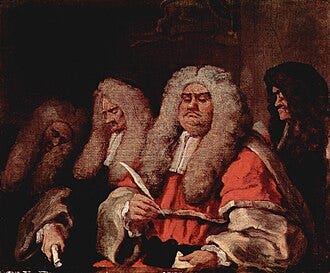
The judges’ concerns are legitimate. But I disagree that what we need is a publicity campaign in support of the status quo. That’s like prescribing sugar pills when what we really want is powerful medicine, radical surgery and possibly a total brain transplant.
Years ago, when my mother was in her 80s and suffering from multiple physical ailments, I had to fly back East to rescue her from the hospital where doctors had prescribed a heavy regimen of anti-depressants. The side-effect of the anti-depressants left my mother unmotivated and somnolent. She lay in her hospital bed in a fetal position. She didn’t respond to my presence or my voice. The doctors recommended that she be institutionalized.
I donned my dark suit, my starched white shirt and red necktie and carried a dark leather attache case. Thus clad in my armor as an attorney, I confronted the white jacketed authority of the hospital psychiatrists.
“Your mother is depressed,” the doctors lectured me. “She is acting irrationally. She needs to be in a nursing home and she needs drugs to elevate her mood (notwithstanding the eggplant condition they induce as a side-effect).”
“My mother is JUSTIFIABLY depressed,” I countered. “She’s old, she’s in pain and she’s in a totalitarian hospital run by you bastards (or words to that effect)! “Her depression is a legitimate and totally rational response to the reality of her life. Considering the situation she’s in, she would be crazy NOT to be depressed!“
I spoke these words with the apparent authority of law, for formally suited and neck-tied as I was, I made it clear to the doctors that I was a lawyer; and nothing frightens doctors more than the sight of a riled up lawyer in a suit.
Exercising my mother’s power of attorney, I terminated the regime of anti-depressants and got her into aggressive physical therapy. Within days after she had “dried out,” I rolled her in a wheelchair down to the hospital parking lot where I enticed her to open the door of her banged up Honda, stick the key in the ignition and start the motor. To older folks, a car is a symbol of independence. My mother looked at me uncertainly, started the car and then asked: “Where am I anyway? Is this a hospital? Why am I here?” To which I could only answer, “You are here because you won’t deal with your problems. Do what you like, Mom. Stay hospitalized or get back on your feet and get out of jail free. I’ll help if you want to be helped. Your choice.”
Days after that, my mother demanded that she be discharged. I brought her home and I flew back to Seattle. She carried on independently for another several years... until she ended up in the hospital again. After which I kidnapped her, closed down her apartment, sold her car, and brought her out West. But this is a sermon, not a personal history, so the next 12 years after the kidnapping abides a later story.
* * * * *
Sorry: I am compelled to launch a screed...
Rather than just preaching our legal catechism to the masses, we really ought to grapple with WHY so many people are cynical about our political and legal system. In my humble opinion, as a lawyer who has practiced law for 47 years, much of the cynicism is justified.
Superficially, the American system of jurisprudence, seems to be too complicated, too expensive, too slow, too ponderous and, ultimately, too unwilling to challenge the authority of the rich or powerful. When you drill down deeper, however, the American system of jurisprudence, seems to be too complicated, too expensive, too slow, too ponderous and, ultimately, too unwilling to challenge the authority of the rich or powerful.
Moreover, although no judge thinks of him or herself as in league with the authority who approved them, no judge - whether a federal judge appointed for life or a state judge appointed pending reelection - is selected without careful political scrutiny of the candidate’s character and career. The unspoken purpose of the political vetting is to predict, generally speaking, how the judge will likely rule in subsequent cases. Everyone knows this. Everyone denies it.
Everyone has predispositions, including judges. This is not to say that judges are inherently “biased,” only that - like all humans - they are conditioned by their experiences to think about things in certain ways. The judicial selection process is not designed to weed out all biases, but to confirm them, subtly or not. The main issue in the judicial confirmation process is which biases will be confirmed. This isn’t a secret because every practicing lawyer researches the social and political proclivities of the judge before stepping foot in any courtroom. Of course, there are good judges and there are bad judges... depending on whether they rule for you or against you.
Can I champion The Rule of Law with a straight face? I would like to, but I cannot. At least, not yet.
We have a President who clearly doesn’t give a rat’s whisker about The Rule of Law. But we also have a political class comprised of - nominally - two parties who sometimes decry the President’s (or the Courts’) derogation of The Rule of Law. But despite their words, the political class nevertheless refuses to rein anyone in. The same “bipartisan” political class continues to fund the misadventures. Over and over again.
They do this, not because they are afraid of the President, but because all politicians, and both political parties, are beholden to their donors. These donors are their constituency. These donors own the state, business, communications, educational, entertainment and news institutions. Regardless of political party, they have the exact same hegemonic objectives as the President. They are happy to let Mr. Trump be pilloried for his hubris in claiming “credit” for his imperial policies, even as they are just as happy to replace him in the next round of elections with someone more polished and articulate... whose core imperial policies will remain the same.
We have a president who talks like a rapist and who fancies himself a combination Roman Emperor/Mafia Godfather. Kids around the world are NOT stupid: they don’t care about what they “learn in school” or what they hear from lawyers about The Rule of Law. They learn how to “get ahead” from what they see the world’s political and business leaders do and they learn about how to “live the good life” from how they see world political and business leaders behave. For the most part, these world leaders - whether in North America or in Europe - behave abysmally. Immorally. Deceitfully. Unethically. Criminally.
Kids see and learn that only they suffer the lashes of The Rule of Law. The patrons of the Jeffrey Epstein recreation-kompromat clubs will never be brought to justice. That gang’s victims were always the young sons and daughters of serfs bound to their patrician estates. So much for The Rule of Law. The kids see and the kids learn what their parents will not.
Historically, the last many centuries of human endeavor have been characterized by the absence of The Rule of Law.
In a courtroom, The Rule of Law can be, more or less, enforced by a Judge in a black robe with a gavel.
In our World as it really is, however, there is no judge or enforcer. What judge will enforce any “deal” signed between the United States and Iran when everyone knows that either the U.S. or Israel or both will violate the deal just as soon as they can get away with it? Does The Rule of Law apply just to those who do not possess nuclear weapons and a credible military and economic deterrence? Apparently so.
Where was The Rule of Law when the U.S. and the U.K. jointly persecuted and imprisoned Julian Assange for publishing the truth at Wikileaks about the invasion and overthrow of Iraq? Where is the Rule of Law when the U.S. continues to operate a prison camp at Guantanamo Bay, Cuba? Those incarcerated in Guantanamo have been imprisoned for more than 20 years without charge, trial or conviction.
The Rule of Law did nothing when the U.S., having bribed the local politicians and generals, kidnapped President Maduro from Venezuela and stole its oil. The Rule of Law does not explain how the political leadership of the world community can remain silent in the face of horrific, homicidal assaults on the civilian populations of Iran, Gaza, the West Bank of Palestine and Lebanon.
Where is The Rule of Law when politicians from both political parties flagrantly profit from insider trading and stock market manipulations that would land any ordinary plebe in prison? Is it The Rule of Law when U.S. real estate developers and crooked Middle East satraps from Saudi Arabia, Kuwait and the UAE cook up schemes to develop Gazan Club Med resorts on the sun-bleached bones of the men, women and children who lived there?
The Judiciary, over the many decades, has shown remarkable, consistent and flaccid restraint when it comes to giving outright passes or a mere slap on the wrist to those who scorn The Rule of Law. In those cases where the right people have been criminally prosecuted and convicted for doing wrong, they will be pardoned by both Democrat and Republican Presidents to benefit their friends, their family and their donors.
The Rule of Law is meaningless when that rule disfavors ordinary people and favors property rights and rentiership; when it simply means Rules for Thee and not for Me.
Unless you wear the rose-colored AI Meta lenses or swallow liberal doses of psychotropic drugs and anti-depressants, like those prescribed for my octogenarian mother, you cannot but see that reality is nothing like the soap that we have been asked to sell.
Except.
I accept and promote the Rule of Law as something aspirational. It is something to be achieved, that can be achieved if, as humanity, we can put our shoulders to the wheel and endeavor to do it. I think that The Rule of Law is a great idea. We should try it some time.
Pardon, Monsieur Elon Musk: Another world is not possible on Mars. But it is possible on this one.
* * * * *
In my humble opinion, the legal system should be run like a public utility. Only then, will the Rule of Law mean anything.
The legal system is, indeed, the skeleton of any functioning society. Lawyers should be public servants, paid and provided to all as necessary - in civil and criminal and administrative matters - as civil servants. There should be no profit incentives in practicing law. Just like there should be socialized medicine that provides basic medical services for everyone. Let private sector lawyers, like private sector doctors, provide for the elective procedures.
The law should be open source and administered for the public good. Just like public education. Just like a functioning, high-speed telecommunications system. Just like open weight artificial intelligence. Just like the Post Office and the passenger trains before they were privatized into decrepitude.
That is what our taxes should pay for - the central, communal, essential functions of our society, like The Rule of Law. Dare I speak the word ‘socialism?’ Because that is what it is in its truest sense: the commons of the law is like the commons of the fields and forests of a time that we have almost forgotten.
And so we have come full circle back to the beginning of this essay.
Are there too many or too few lawyers? Should the Bar Examination be easier or harder? Should there be any Bar Examination at all?
Perhaps, one day, all the lawyers... and the judges... will be replaced by artificially intelligent robots using the same AI weights and tokens. We might soon be vibe coding the law, no bar exam necessary. For better or worse, that day might be close at hand.
Meanwhile, seven hundred lawyers walk into a bar one day. Then the bar disappears.
Funny or not? It depends on who you are. And what you think about The Rule of Law.
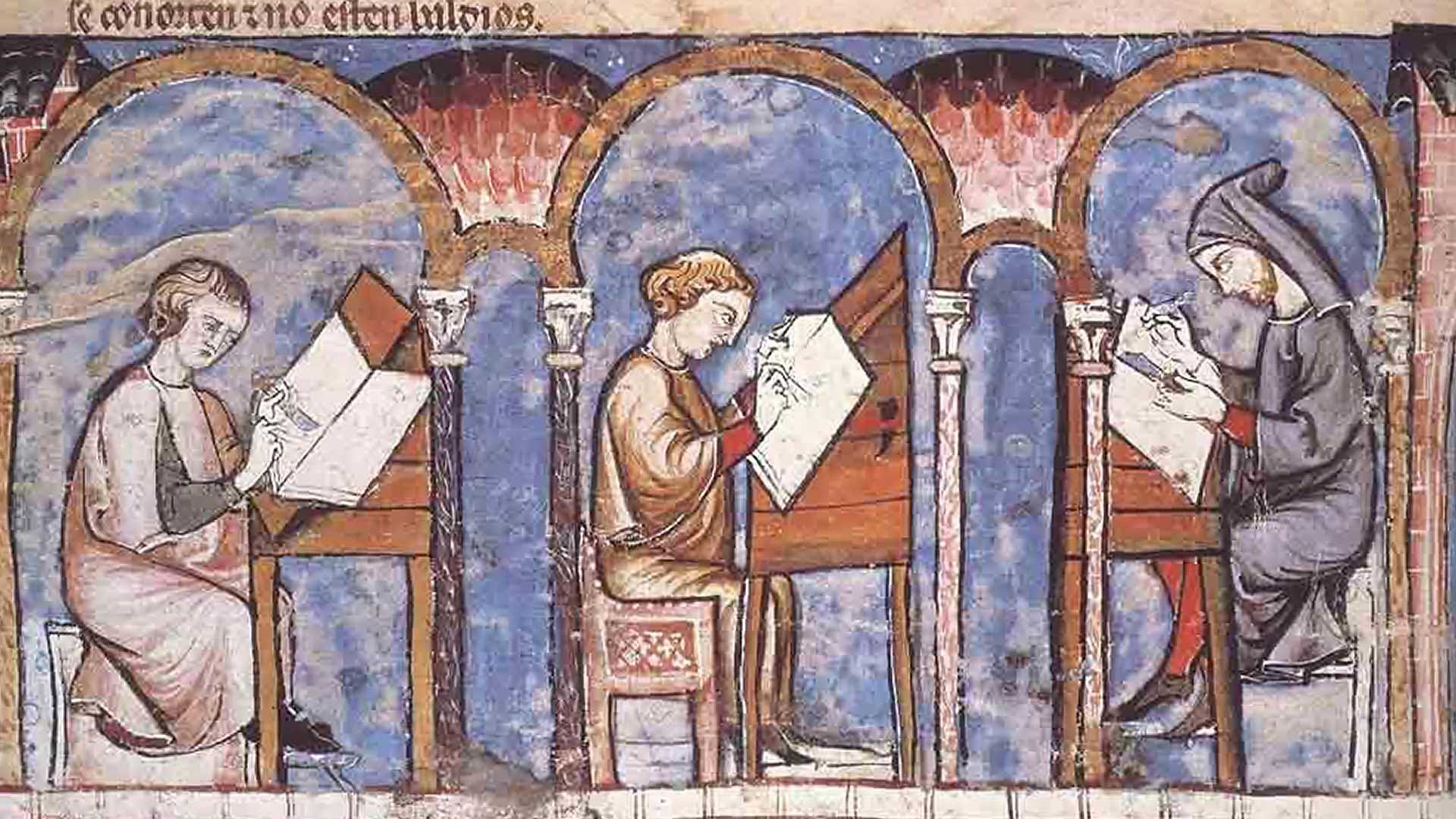
AI generated “monk scribing” - Qwen 3.8 - Max
* * * * * * * *
Steve,
Thanks for this. You continue to cause me to challenge my beliefs and education. I find that, at this stage of my life, I’m not always ready for that. 😳